
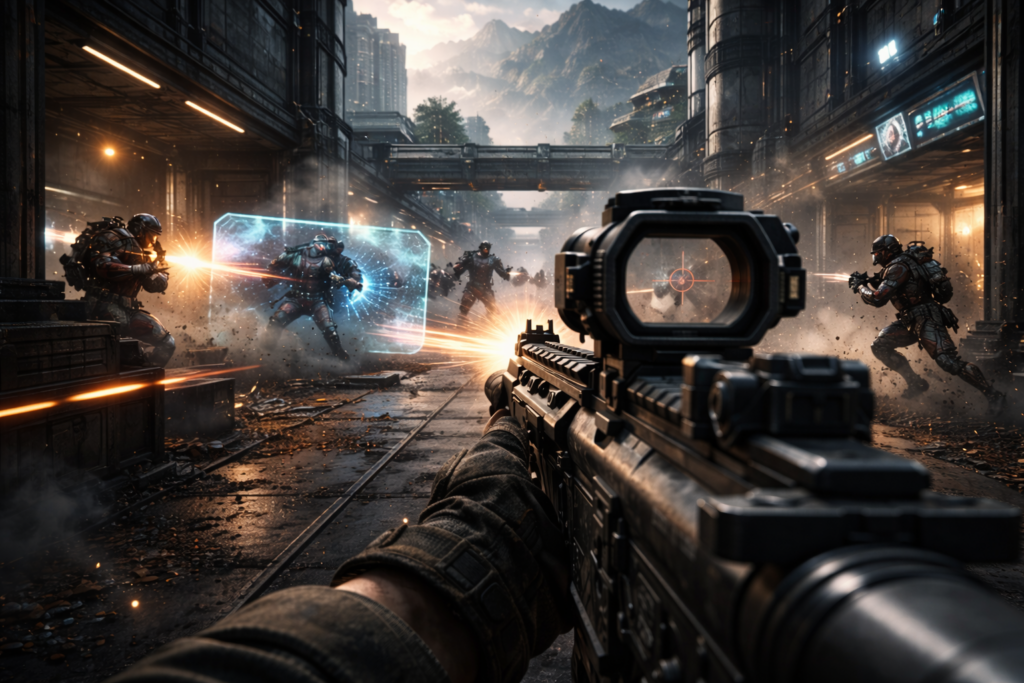
At Low Rank, Mistakes Are Forgiven. At High Rank, They Are Punished.
Apex Legends feels manageable in Gold.
It feels intense in Diamond.
At Predator level, it becomes a reaction-time compression chamber.
The difference is not aim alone.
It is speed of processing under chaos.
This is not a gameplay review.
This is a reaction-time stress test.
How fast is fast enough to compete at high rank in Apex Legends?
Let’s measure it.
1. The True Reaction Window in Apex
Average human reaction time:
~200–250ms visual response.
In high-rank Apex close-range engagements, the effective window is often:
Under 150ms.
Why?
Because elite players pre-aim, pre-fire, and micro-strafe aggressively.
When an enemy swings a corner:
- First bullet often lands within 100–150ms.
- Armor cracks can occur within 300–400ms.
- One missed micro-adjustment equals knock.
You are not reacting to a stationary target.
You are reacting to a strafing, sliding, crouch-spamming opponent.
This compresses viable response time dramatically.
If your reaction plus correction exceeds 180–200ms, you are statistically behind.
2. Tracking Precision Under Micro-Movement
Unlike flick-heavy shooters, Apex demands sustained tracking.
Close-range SMG fights require:
- Continuous micro-adjustment
- Recoil control
- Strafe counter-correction
- Aim stabilization under flinch
This is where reaction time becomes layered:
Layer 1: Visual recognition
Layer 2: Motor initiation
Layer 3: Continuous correction
Many players pass Layer 1.
They fail Layer 3.
High rank Apex punishes delayed micro-corrections more than delayed initial reactions.
Tracking delay of even 40–60ms results in:
- Lost DPS race
- Armor disadvantage
- Forced retreat
- Third-party vulnerability
The punishment curve is immediate.
3. Sensory Overload in Multi-Squad Fights
Apex is one of the most aggressive sensory overload gaming environments available.
During a single third-party engagement, you process:
- Two to three separate gunfire directions
- Footstep audio differentiation
- Tactical ability cues
- Ultimate activations
- Shield crack audio
- Teammate comms
- Kill feed information
- Ring timer pressure
Your working memory is saturated.
Under overload, reaction time slows.
Even 20–30ms cognitive delay compounds in fast decision games.
This is why many mechanically strong players collapse during chaotic third parties.
They are not slow.
They are overloaded.
Elite Apex competitors filter instantly.
They ignore non-critical noise.
They act on priority threat.
Calm equals weaponry.
4. Armor Swap Windows: The 300ms Test
One of Apex’s purest reaction stress moments:
The armor swap.
In high-rank lobbies:
- Downed enemy box appears.
- You must recognize it.
- Move cursor precisely.
- Swap armor.
- Re-engage.
The entire process often occurs in under 300–400ms.
Delay beyond that:
- Incoming third-party beams you.
- Knock becomes squad wipe.
Armor swaps separate average Diamond from Predator players.
This is not mechanical talent alone.
This is recognition speed + input precision under pressure.
5. Movement APM Requirements
Apex Predator gameplay includes:
- Slide jumps
- Tap strafes
- Wall bounces
- Strafing rhythm manipulation
- Jiggle peeking
- Quick shield cells
- Crouch spam timing
APM requirements spike during fights.
But the real test is decision-per-minute density.
During a 10-second fight you may decide:
- Commit or disengage?
- Swap weapon or reload?
- Pop cell or swing?
- Climb height or anchor?
- Chase crack or reset?
That is decision compression layered on mechanical demand.
Hesitation at any node leads to elimination.
6. The Punishment Curve for Hesitation
At lower ranks:
You miss shots.
Opponent misses shots.
Fight resets.
At high rank:
You miss 3 bullets.
Opponent does not.
Fight over.
The punishment curve steepens dramatically in Master/Predator lobbies.
Mistakes that cost 20 HP in Platinum cost full elimination in Predator.
This creates psychological compression.
You know mistakes are lethal.
That awareness increases stress.
Stress slows reaction.
Only trained composure protects execution.
7. Third-Party Compression
The defining Apex variable:
Third parties.
Gunfire acts as magnet.
After first knock:
- 10–20 seconds until another team arrives.
- Sometimes less.
This forces hyper-efficient decision-making:
- Finish squad fast?
- Reset immediately?
- Armor swap before revive?
- Hold choke or rotate out?
You cannot think slowly.
The environment does not allow it.
High-rank Apex is a constant reaction-time stress test layered over strategic decision density.
8. Where Players Lose Milliseconds
Common micro-delays:
- Over-confirming crack before pushing.
- Hesitating before armor swap.
- Double-checking angle before swing.
- Slow shield cell cancel timing.
- Late weapon swap during reload punish.
Each delay feels minor.
Collectively, they are fatal.
Predator players eliminate internal lag.
Their actions appear instinctive.
In reality, they are pre-trained responses.
9. Fatigue Multiplier in Apex
Fast games drain cognitive bandwidth quickly.
After 2–3 hours:
- Tracking becomes jittery.
- Decision clarity fades.
- Micro-corrections lag.
- Audio filtering weakens.
Apex punishes fatigue more harshly than slower shooters.
Endurance is wise recovery.
Elite players manage:
- Session length
- Hydration
- Mental resets between matches
Speed requires sustainability.
10. How Fast Is Fast Enough?
To compete at Predator level in Apex:
You must:
- React under 180ms consistently
- Track smoothly under micro-movement
- Execute armor swaps under 400ms
- Make fight-level decisions under 1 second
- Filter non-critical sensory input instantly
Raw reaction alone is insufficient.
You need:
- Anticipation
- Composure
- Reduced live decision trees
- Energy management
Speed without discipline collapses.
Final Assessment: Apex as a Reaction-Time Benchmark
If you want to measure your reaction ceiling in modern FPS environments, Apex Legends is the stress test.
It demands:
- High APM requirements
- Tracking precision
- Micro-decision density
- Third-party awareness
- Emotional regulation under chaos
At low ranks, errors are survivable.
At high ranks, they are terminal.
Apex does not reward the fastest player.
It rewards the fastest stable thinker.
Speed peaks early.
Composure sustains it.
Eliminate internal lag.
Train anticipation.
Protect recovery.
Because in Apex Legends at high rank —
Milliseconds decide survival.