
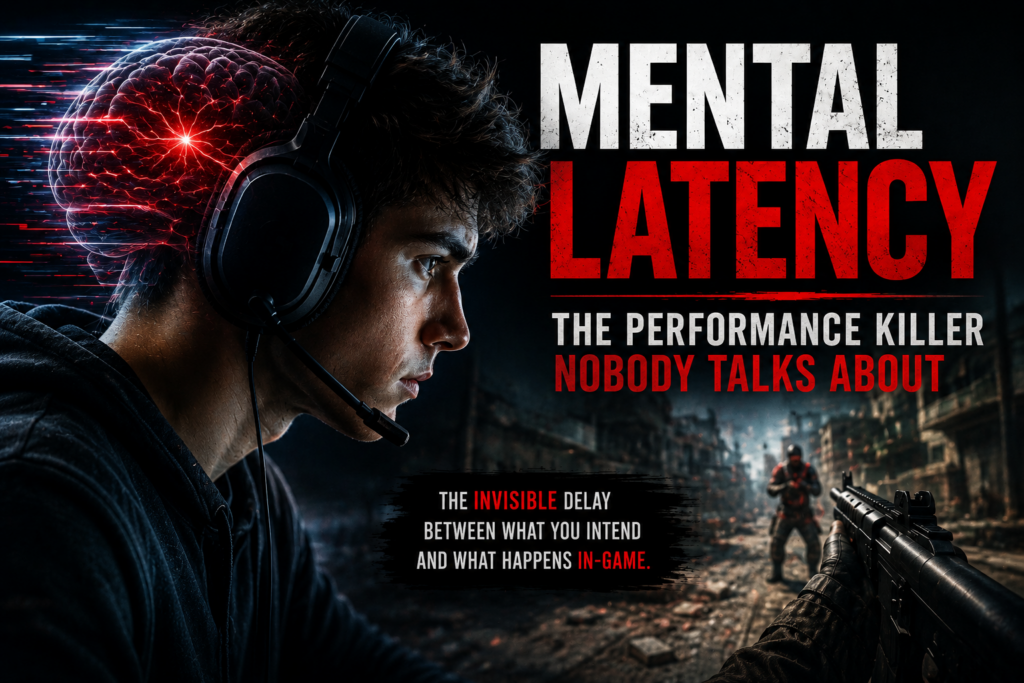
Most Gamers Are Optimizing the Wrong Latency
Competitive gamers spend thousands of dollars reducing latency.
They buy faster monitors, lower input lag peripherals, optimized internet connections, and high-performance PCs. Every millisecond matters, and serious competitors know it.
Yet many players still experience a frustrating reality.
Their hardware is fast.
Their internet is stable.
Their frame rates are high.
But something still feels slow.
You see the enemy a fraction too late.
You hesitate before making a decision.
You miss information that should have been obvious.
Your reactions feel delayed even though your setup isn’t.
The problem may not be your equipment.
The problem may be your brain.
This hidden delay is what we call mental latency.
Mental latency is the gap between what you perceive and how quickly your brain processes, decides, and responds. Unlike hardware latency, which can be measured with software and equipment, mental latency is largely invisible.
But its impact on performance can be enormous.
In many cases, the difference between average and elite competitors isn’t reaction speed alone. It’s how efficiently they process information under pressure.
The fastest players aren’t always the ones with the quickest reflexes.
They’re often the ones with the lowest mental latency.
What Is Mental Latency?
Mental latency is the delay that occurs between:
- Receiving information
- Processing information
- Making a decision
- Executing an action
Every competitive game relies on this cycle.
A player spots movement.
The brain identifies the threat.
The brain chooses a response.
The hands execute the action.
This process happens thousands of times during a single gaming session.
When mental latency is low, information flows quickly and efficiently.
When mental latency is high, performance begins to break down.
The dangerous part is that most players don’t recognize what’s happening.
They assume:
- Their aim is off
- Their reactions are slow
- They’re having a bad day
- Their opponents are simply better
In reality, the issue may be occurring much earlier in the chain.
The brain is taking longer to process information.
Hardware Latency vs Mental Latency
Most gamers understand hardware latency.
Examples include:
- Input lag
- Display latency
- Network latency
- Frame timing issues
These delays occur between the player and the game.
Mental latency occurs inside the player.
Think of it this way:
A 240Hz monitor can display information extremely quickly.
But if your brain takes an extra 200 milliseconds to process what it’s seeing, the monitor’s advantage becomes less meaningful.
This is why two players can use identical setups and perform very differently.
One player instantly recognizes patterns and reacts.
The other player sees the same information but requires more time to interpret it.
The difference isn’t hardware.
It’s processing efficiency.
Why Mental Latency Matters in Competitive Gaming
Mental latency affects nearly every aspect of performance.
Reaction Time
Most players think reaction time is purely physical.
It’s not.
Reaction time consists of multiple stages:
- Visual recognition
- Threat identification
- Decision making
- Motor execution
Mental latency affects the first three.
If the brain processes information more slowly, reactions naturally become slower.
Decision Making
Competitive games rarely reward simple reactions.
They reward decisions.
A Valorant player choosing whether to rotate.
An Apex player deciding whether to push.
A Warzone player identifying whether a sound cue represents danger.
These situations aren’t reflex tests.
They’re information processing challenges.
When mental latency increases, decisions become slower and less accurate.
Situational Awareness
Awareness depends on how much information the brain can process simultaneously.
Players experiencing mental latency often report:
- Missing obvious enemy positions
- Forgetting critical information
- Tunnel vision
- Poor map awareness
The information exists.
The brain simply isn’t processing it efficiently.
Consistency
Perhaps the biggest impact of mental latency is inconsistency.
Most players don’t perform poorly all the time.
They perform poorly at specific moments.
Late in sessions.
Under stress.
After extended concentration.
During high-pressure situations.
These are exactly the conditions that increase mental latency.
The Four Major Causes of Mental Latency
1. Cognitive Fatigue
The brain consumes enormous amounts of energy during competitive gaming.
Every engagement requires:
- Threat assessment
- Positioning analysis
- Decision making
- Adaptation
Over time, these processes become less efficient.
Just as muscles fatigue after exercise, cognitive systems fatigue after prolonged mental effort.
This is one reason players often perform worse after several hours of gaming.
The hardware hasn’t changed.
The brain has.
2. Information Overload
Modern competitive games bombard players with information.
Health bars.
Audio cues.
Enemy positions.
Cooldowns.
Objectives.
Team communication.
Movement patterns.
The brain must filter and prioritize this information in real time.
When information exceeds processing capacity, mental latency increases.
Players begin falling behind the pace of the game.
Not because they’re slower.
Because they’re overloaded.
3. Stress and Pressure
Pressure changes cognitive performance.
In moderation, stress can improve focus.
Too much stress has the opposite effect.
Players begin overthinking.
Decision speed decreases.
Processing efficiency drops.
This is why players often perform worse in ranked matches than in casual games despite possessing identical skill.
The pressure introduces additional mental latency.
4. Poor Recovery
Sleep, nutrition, hydration, and recovery directly affect cognitive performance.
A fatigued brain processes information less efficiently.
This doesn’t always feel like exhaustion.
Instead, it often appears as:
- Slower decisions
- Missed information
- Reduced awareness
- Increased mistakes
Many players mistake these symptoms for a lack of skill.
They’re often signs of insufficient recovery.