Every competitor reaches a crucial point.
Configuring the optimal battlefield is essential.
Many overlook foundational elements.
Too often, players resort to expensive upgrades.
Solutions lie not only in hardware, but in disciplined configuration.
Conducting Reconnaissance Before Upgrades
Before investing, measure your performance metrics.
Use tools like FRAPS or MSI Afterburner.
Monitor frames per second (FPS) and input delay.
Identify where the bottlenecks are occurring.
Common areas include GPU, CPU, and peripheral lag.
The Latency Stack You Must Address
Input latency can ruin crucial moments.
Start with your display settings.
A refresh rate of 144Hz is optimal for competitive play.
Ensure your monitor supports this.
Your peripherals should also maintain high polling rates.
Set your mouse to 1000Hz and check your keyboard configuration.
Specific Hardware Fixes and Upgrade Paths
An upgrade may involve the graphics card.
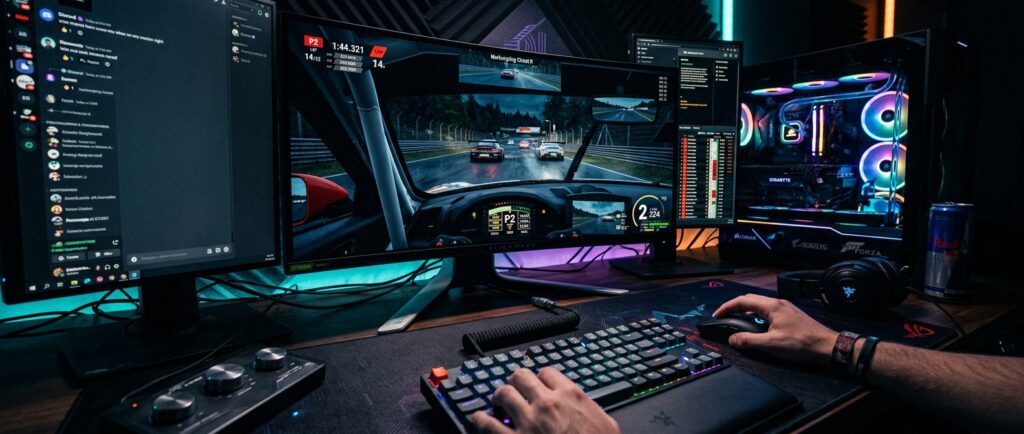
If consistently below 60 FPS in high-stakes races, consider a jump to a higher-tier GPU.
Consider hardware like the NVIDIA RTX 3060 Ti or AMD RX 6700 XT.
Ensure your drivers are up-to-date for optimal performance.
Avoiding Costly Configuration Pitfalls
Many players misconfigure their settings.
High sensitivity often leads to lack of control.
Set mouse sensitivity to a lower value for precision.
Test the feel through consistent tracking exercises.
The Importance of Stability and Consistency
Configurations must hold up under pressure.
Test your setup with long gaming sessions.
Monitor for thermal throttling; ideally, keep temperatures under 80°C.
Ensure power supply stability; fluctuations can cause performance drops.
Why Configuration Discipline Compounds Performance
Even small adjustments yield significant results.
Find flow under fire through optimized settings.
A disciplined approach to configuration minimizes internal lag.
You are more than a player; you are a tactical competitor.
Tactical Takeaways
- Calibrate peripheral settings for optimal response rates.
- Consistently check and optimize thermal management.
- Utilize benchmarking tools for performance analysis.
- Invest time in understanding system latencies.
Hardware does not win matches.
Disciplined configuration does.
Optimize first.
Spend second.