
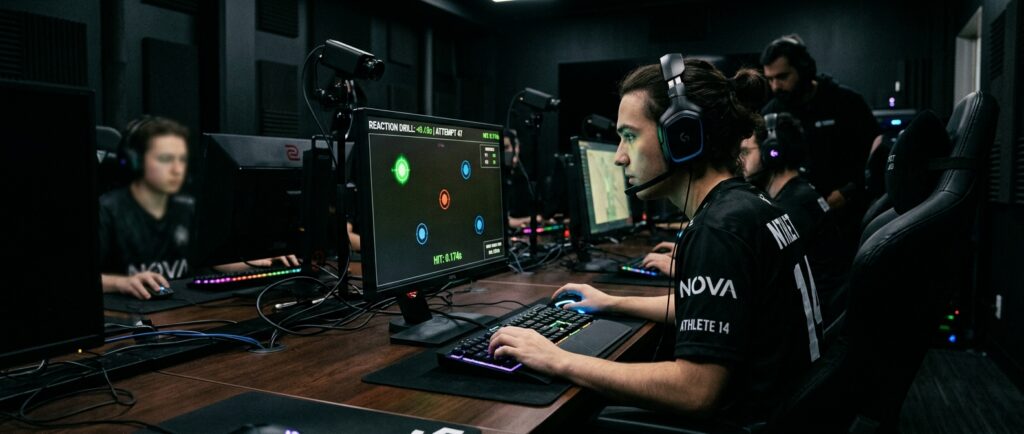
Aim trainers are not the bottleneck.
Decision speed is.
Everyone can flick.
Few can decide under pressure.
To excel in high-stakes environments, elite competitors must upgrade not just their mechanical skills, but their cognitive resilience.
Every moment of hesitation costs more than just time.
It costs victory.
What Reaction Time Really Is
Reaction time is the interval between stimulus and response.
It’s a critical component in high-pressure gaming scenarios.
This skill is often mistakenly viewed as purely mechanical.
In reality, optimal reaction involves both cognitive processing and physical execution.
It’s about illuminating the path from thought to action.
Why Players Plateau in Reaction Time
Many players become trapped in response drills.
They focus extensively on speed without understanding the factors that contribute to effective decision-making.
Environmental stress, cognitive overload, and emotional regulation can lead to internal lag.
This is where most training fails.
Discipline is smart fighting.
The Tactical Protocol for Reaction Time Enhancement
Implement the following training protocol to upgrade your reaction time.
- Warm-Up (10 minutes): Engage in light finger exercises to promote dexterity.
- Visual Response Drill (15 minutes): Use a reaction time app or a partner calling out random colors or numbers.
- Delayed Reaction Training (15 minutes): React to unpredictable stimuli in a controlled environment. Utilize both auditory and visual cues.
- Simulated Pressure Scenarios (20 minutes): Play in a modified scrimmage with added stressors, such as timers or live feedback from teammates.
- Cool Down (10 minutes): Reflect on performance, noting both successes and areas for improvement. Use breathing techniques to alleviate stress.
Measuring Progress and Understanding Changes
Track your reaction times both in drills and in-game.
Use tools that provide metrics on response accuracy and decision-making speed.
As you refine your protocol, observe how decision-making under pressure improves.
Eliminating internal lag is the goal.
Recovery and Consistency Considerations
Recovery is ammunition for further development.
Incorporate active recovery days focusing on mental rest.
Stress adaptation is crucial.
Overworking will lead to burnout, spiraling into a decline in performance.
Balance practice with recovery to maintain consistency.
Why Disciplined Repetition Compounds
Repetition needs to be deliberate to be effective.
Quality over quantity becomes pivotal at elite levels.
Each training session should build upon the last.
Skill wins battles. Discipline wins wars.
This principle applies to mastering reaction time as much as tactical movement.
Tactical Takeaways
- Integrate diverse stimuli for reaction drills.
- Measure your progress systematically.
- Prioritize recovery through mental and physical techniques.
- Ensure each session has a clear focus on improving decision-making speed.
- Emphasize disciplined practice over random adaptations.
Pressure exposes untrained habits. Discipline builds them in.
Train the system, not the moment.
Find flow under fire.