
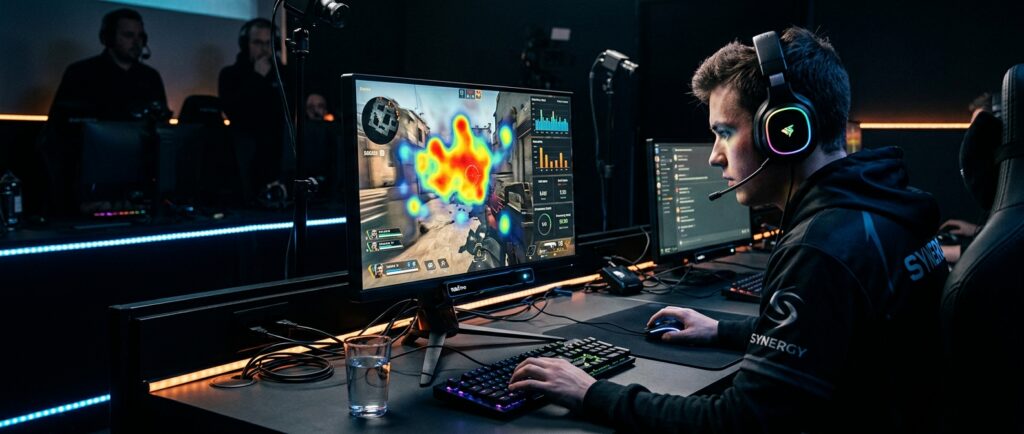
At low rank, mistakes survive.
At high rank, they are punished instantly.
Mechanics stop being the separator.
Cognitive stability becomes the advantage.
The Cognitive Pressure of Elite Competition
High-ranking esports environments impose relentless cognitive demands.
Reaction time windows compress under competitive pressure.
The average player may enjoy a 200ms reaction margin.
Elite competitors operate within 100ms.
This leaves no room for hesitation.
Decision Density Under Tactical Stress
In high-stress scenarios, decision-making bandwidth is severely taxed.
Players face multiple split-second choices.
Every moment spent considering options is an opportunity lost.
Elite competitors embrace anticipatory strategies.
Success hinges on identifying potential threats preemptively.
Sensory Overload: The Hidden Adversary
The modern esports arena bombards players with information.
Visual clutter and audio cues create a sensory overload state.
This environment can overwhelm working memory and processing capacity.
Calm equals weaponry here.
Staying composed allows mental clarity amidst chaos.
Cognitive Saturation and Emotional Regulation
Intense gaming sessions can lead to cognitive saturation.
Fatigue is not merely a physical state; it is a mental barrier.
Emotional instability can derail a champion’s focus.
Effective emotional regulation strategies are critical.
Pausing to reset emotionally can reestablish tactical control.
The Punishment Curve: Where Seconds Matter
Every millisecond of hesitation may culminate in defeat.
Under rapid-fire conditions, the punishment curve steepens.
A late reaction to an opponent’s peak moment can turn the tide of battle.
Here, discipline outweighs raw skill.
High-stakes environments favor consistent performers over fleeting successes.
Endurance and Tactical Recovery Systems
Recovery is ammunition in elite gaming.
Sustaining performance under duress requires effective recovery techniques.
Structured breaks and mental resets normalize reaction time.
Proficient athletes integrate deliberate downtime to recharge cognitive capacities.
This creates a sustainable rhythm under intense pressure.
Tactical Takeaways
- Develop anticipatory skills to predict and react to threats.
- Implement emotional control techniques to stabilize focus during high pressure.
- Prioritize structured recovery regimens to optimize cognitive readiness.
- Engage in deliberate practice to enhance mechanical execution under stress.
- Utilize breathing techniques to manage sensory overload and maintain composure.
The fastest stable thinker survives.
Train anticipation.
Eliminate internal lag.
Find flow under fire.